Project A8 - Modelling of Magnetoelectric Sensors
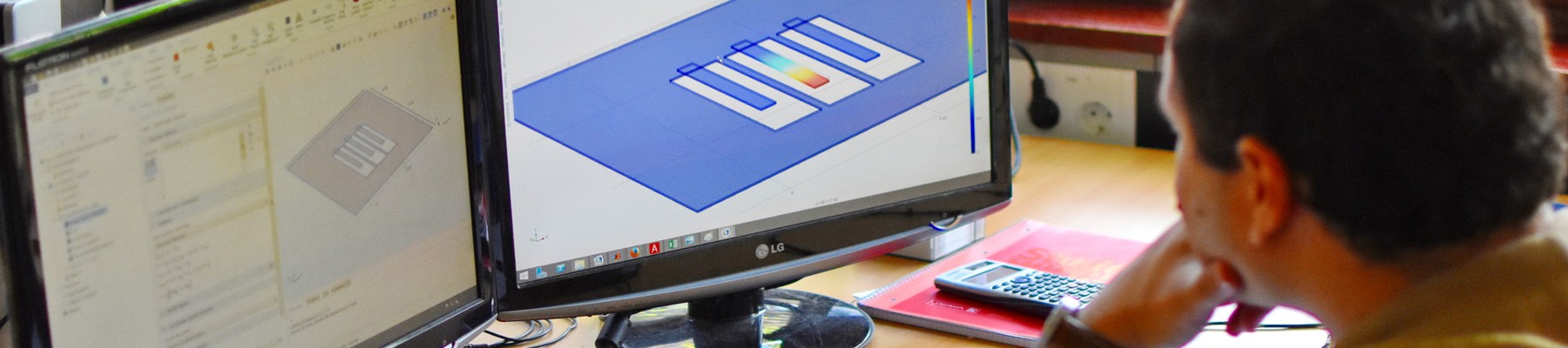
The aim of this project is a theoretical investigation of the behavior of magnetoelectric (ME) sensors and sensor arrays based on combinations of piezoelectric and magnetostrictive materials. In prior research, analytical and numerical methods were developed for simulating the magnetic-field response of sensors as well as their behavior in inhomogeneous biomagnetic fields. In the next funding period, the objectives are again twofold – theoretical investigation of novel sensor designs and theoretical analysis and design of sensor systems. Simulations will mainly be conducted using the finite-element method. On the sensor side surface-acoustic-wave (SAW) sensors with phononic crystal (PnC) resonant enhancement will be investigated. Resonant enhancement by structuring the magnetostrictive phase allows for an amplification for small signal amplitudes while also influencing the magnetic properties. A detailed study of the combined effects will be carried out for different configurations based on finite-element-method simulations. The theoretical results will be compared to experimental results in A9, and magnetic properties of structured magnetostrictive layers will be implemented in cooperation with A10. The investigation will start with purely periodic structuring as well as resonators formed by symmetry breaking. Next, impedance-matching structures based on changing the filling factor of material per period will be introduced. Phononic metasurfaces with high design freedom will be investigated. Here, the theoretical investigation will allow for new insights based on combining the changes of magnetic properties with geometry and with the changes in SAW propagation. The second focus will be the multiscale modelling of vector sensor systems for biomedical applications. In particular, the design of the sensor system approaches for measuring magnetic nanoparticles (MNP) based on ΔE-Effect sensors (A4), converse ME sensors (A7) and SAW ME sensors (A9) will be evaluated. On the application side the focus will be on the collaboration with B12 regarding MNP implants. The response of the MNP implant will be simulated for molecular binding following different biomarker concentrations. Detection signals at different detection distances will be modelled. A particular focus will be on the interaction with biological tissue regarding the effects of sensor coupling via secondary currents. The propagation of noise effects needs to be considered and active cancellation approaches will be investigated in a theoretical study. The theoretical results will be compared to experimental results obtained in B12.
Involved Researchers
| Person |
Role |
 |
Prof. Dr. Martina Gerken
Electrical Engineering
Integrated Systems and Photonics |
Project lead |
 |
M.Sc. Giuseppe Barbieri
Electrical Engineering
Integrated Systems and Photonics |
Doctoral researcher |
 |
Dr.-Ing. Mohsen Samadi
Electrical Engineering
Integrated Systems and Photonics |
Postdoctoral researcher |
Role within the Collaborative Research Centre
Exchange on modelling topics with other projects will take place in the focus group F2 - Modelling, which is
headed by Prof. Gerken. This project will join focus groups F4 - Magnetoelectric Sensors and F5 - Concepts based on Delta-E Effect for the development of sensors as well as the group F6 - Biomedical Applications to discuss
the link of the sensor properties to the applications. This project will support the dissemination activities in
SOP, and the doctoral researchers will be active in the IRTG. This project will collaborate closely on the sensor design with the technology groups in Research Area A
and on inhomogeneous field effects with Research Area B. Specifically, the following collaborations are
planned:
| Collaborations |
| A1 (Magnetostrictive Multilayers for Magnetoelectric
Sensors) |
Magnetostrictive material parameters obtained from A1. |
| A4 (∆E-Effect Sensors) |
Joint analysis of time-dependent behavior of ΔE-Effect sensors. |
| A6 (Microstructure and Structural Change of
Magnetoelectric Sensors) |
Joint analysis of SAW sensors with phononic crystals and metasurfaces. |
| A7 (Electrically Modulated Magnetoelectric Sensors) |
Sensor and coil design for magnetic-nanoparticle readout will be investigated together with
A7. Joint analysis of time-dependent sensor behavior. |
| A9 (Surface Acoustic Wave Magnetic Field Sensors) |
Phononic-crystal SAW sensors will be investigated in close collaboration with A9. Designs
will be provided to A9, experimental results will be obtained from A9, and the next steps will
be planned together. Joint analysis of time-dependent sensor behavior. |
| A10 (Magnetic Noise of Magnetoelectric Sensors) |
Magnetic noise model obtained from A10. Layer deformation and full sensor calculations will
be provided to A10. |
| B1 (Sensor Noise Performance and Analogue System Design) |
Experimental results on sensor performance of B1 will be integrated into the simulation. |
| B2 (Digital Signal Processing) |
Experimental data on the time-dependent behavior of sensors will be obtained from B2.
Modelling results will be provided to B2. |
| B12 (Bioinspired Nanocomposites for Early Detection
of Complications in Gastrointestinal Surgery) |
System design for magnetic-nanoparticle readout systems will be delivered. Experimental
results obtained from B12 will be used to improve the design and prediction simulation. |
Project-related Publications
|
M. Samadi, J. M. Meyer, E. Spetzler, B. Spetzler, J. McCord, F. Lofink, M. Gerken: Modeling of High-Sensitivity SAW Magnetic Field Sensors with Au-SiO2 Phononic Crystals, Advanced Sensor Research, vol. 4(5), 2500008, 2025. |
|
N. Ziehm, J. Arbustini, E. Elzenheimer, M. Samadi, G. Barbieri, M. Gerken, M. Höft, R. Rieger, A. Bahr: MEMS-based Narrow-Bandwidth Magnetic Field Sensors: Preliminary Assessment of Prototypes regarding Coercivity, Remanence, and Sensitivity, Biomedical Engineering / Biomedizinische Technik, 2025. |
|
M.-Ö. Özden, G. Barbieri, M. Gerken: A Combined Magnetoelectric Sensor Array and MRI-Based Human Head Model for Biomagnetic FEM Simulation and Sensor Crosstalk Analysis, MDPI Sensors, 24(4), 1186, doi: 10.3390/s24041186, 2024. |
|
M.-Ö. Özden, J. Schmalz, M. Gerken: A Combined Magnetoelectric Sensor and Human Head Model for Biomagnetic FEM Simulations, IEEE Sensors Journal, vol. 23, no. 24, pp. 30259-30270, doi: 10.1109/JSEN.2023.3329579 2023. |
|
M. Samadi, J. Schmalz, J. M. Meyer, F. Lofink, M. Gerken: Phononic-Crystal-Based SAW Magnetic-Field Sensors, SMicromachines, 14(11), 2130, 2023. |
|
J. Schmalz, E. Spetzler, J. McCord, M. Gerken: Investigation of Unwanted Oscillations of Electrically Modulated Magnetoelectric Cantilever Sensors, MDPI Sensors, no. 11, issue 11, pp. 5012, 2023. |
|
M.-Ö. Özden, M. Gerken: Trade-Off between Spatial Resolution and Sensitivity of Magnetoelectric Magnetic Field Sensors, International Conference on Electromagnetics in Advanced Applications (ICEAA), 2021. |
|
J. Schmalz, M. Krantz, A. Knies, H. Lüder, M. Gerken: Signal-to-Noise Ratio Enhanced Electrode Configurations for Mgnetoelectric Cantilever Sensors, AIP Advances, vol. 10, issue 7, 075314, 2020. |
|
S. Zuo, J. Schmalz, M.-Ö. Özden, M. Gerken, J. Su, F. Niekiel, F. Lofink, K. Nazarpour, H. Heidari: Ultrasensitive Magnetoelectric Sensing System for Pico-Tesla MagnetoMyoGraphy, IEEE Transactions on Biomedical Circuits and Systems, vol. 14, issue 5, 2020. |
|
J. Schmalz, B. Spetzler, F. Faupel, M. Gerken: Love Wave Magnetic Field Sensor Modeling — from 1D to 3D Model, International Conference on Electromagnetics in Advanced Applications (ICEAA), pp. 0765-0769, 2019. |
|
M. Krantz, M. Gerken: Fundamental Thermal Limits for Detection of Biomedical Magnetic Fields by Resonant Magnetoelectric Composite Sensors, Abstract von Today's Noise Tomorrow's Signal, Berlin, Deutschland, 2019. |
|
A. Kittmann, P. Durdaut, S. Zabel, J. Reermann, J. Schmalz, B. Spetzler, D. Meyners, N. X. Sun, J. McCord, M. Gerken, G. Schmidt, M. Höft, R. Knöchel, F. Faupel, E. Quandt: Wide Band Low Noise Love Wave Magnetic Field Sensor System, Scientific Reports, vol. 8, no. 278, 2018. |
|
B. R. Holländer, C. Müller, J. Schmalz, M. Gerken, J. McCord: Magnetic Domain Walls as Broadband Spin Wave and Elastic Magnetisation Wave Emitters, scientific reports, vol. 8, no. 13871, 2018. |
|
J. Schmalz, A. Kittmann, P. Durdaut, B. Spetzler, F. Faupel, M. Höft, E. Quandt, M. Gerken: Comparison of the Fundamental and Higher Order Love Waves’ Sensitivities in a SAW Based Magnetic Field Sensor, SAW Symposium 2018, Dresden, 2018. |
|
S. B. Hrkac, C. T. Koops, M. Abes, C. Krywka, M. Müller, M. Burghammer, M. Sztucki, T. Dane, S. Kaps, Y. K. Mishra, R. Adelung, J. Schmalz, M. Gerken, E. Lage, C. Kirchhof, E. Quandt, O. M. Magnussen, B. M. Murphy: Tunable Strain in Magnetoelectric ZnO Microrod Composite Interfaces, ACS Appl. Mater. Interfaces, 9 (30), pp. 25571–25577 , 2017. |
|
M. Krantz, M. Gerken J. Schmalz: Magnetoelectric Cantilever Theory: Effect of Elastic Seed and Adhesion Layers and Multi-Domain Concepts on Response of Exchange Bias Multilayer Sensors, Euro Intelligent Materials, 2017. |
|
J. Schmalz, F. Faupel, M. Gerken, A. Kittmann, E. Quandt, E. Yarar, S. Zabel:Influence of a Magnetostrictive Layer on the Mode Shape and Wave Velocity of Love-Wave Based SAW-Device, Euro Intelligent Materials 2017, Kiel, 2017. |
|
J. L. Gugat, M. C. Krantz; J. Schmalz, M. Gerken: Signal-to-Noise Ratio in Cantilever Magnetoelectric Sensors, IEEE Transactions on Magnetics, vol. 52, issue 9, 2016. |
|
J. L. Gugat, M. C. Krantz, J. Schmalz, M. Gerken: Magnetic Flux Concentration Effects in Cantilever Magnetoelectric Sensors, IEEE Transactions on Magnetics, vol. 52, no. 5, pp. 1-8, 2016. |